
Trade Hounds
Material Management Software, LLCSocial
3.9193.00 Reviews
- Version
- 5.2.0
- Installs
- 100.00K
- Age Rating
- Teen
Screenshots
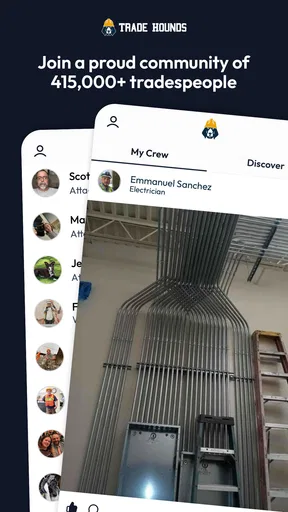
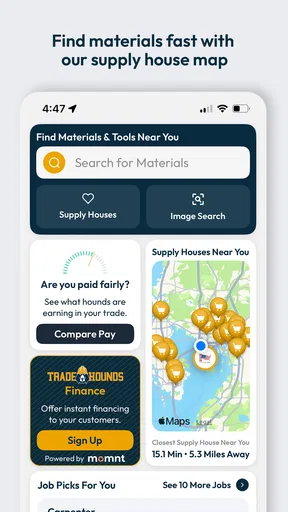
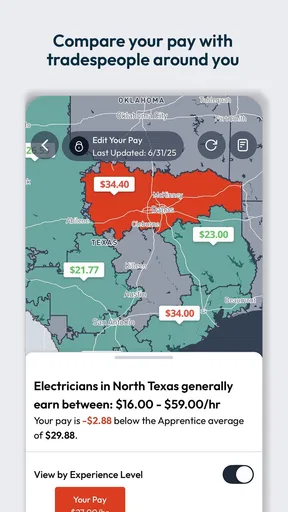
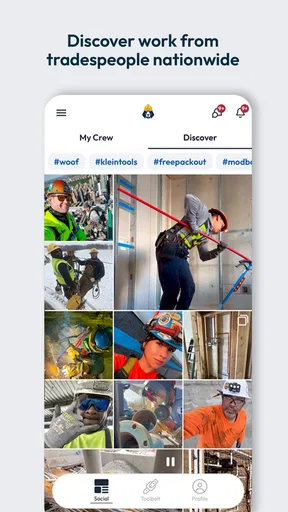
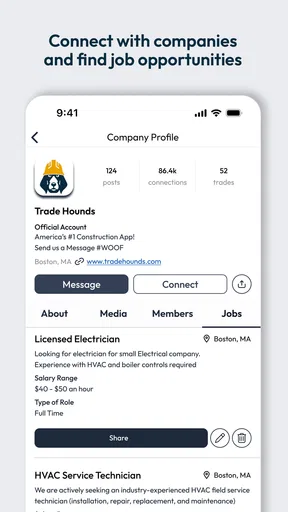
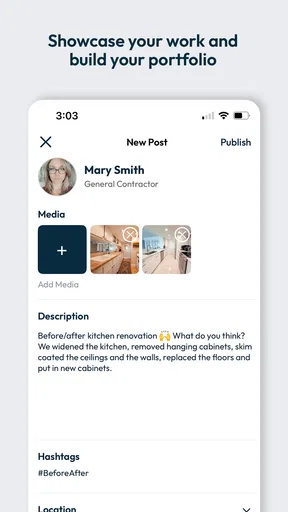
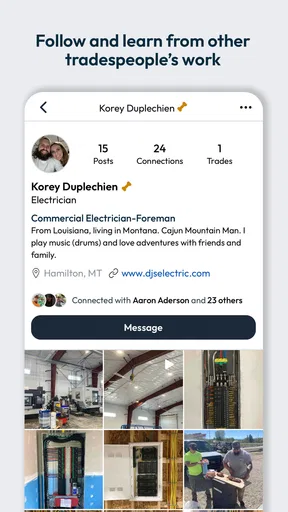
Our Review of Trade Hounds
 Analysis by Appyee
I came to Trade Hounds looking for something more useful than another general-purpose social feed. Its focus is construction, and that changes the way the app feels from the first screen: the likely audience is made up of people who want to talk about work, find practical advice, share what they are seeing on site, and connect with others who understand the trades. It is a free social app from Material Management Software, LLC, with a Teen content rating, and I found its strongest value in the way it narrows the conversation around a working community.
The starting condition for using it is fairly clear. If your daily life involves tools, crews, materials, schedules, job-site problems, or learning a trade, a broad social network can feel noisy. Trade Hounds is designed to reduce that distance. Instead of explaining every construction reference to people outside the industry, you can enter a space where the subject matter is already familiar. That does not make every post useful, but it gives the app a purpose that ordinary social platforms often lack.
After spending time with it, I would describe Trade Hounds as a community app rather than a formal project-management tool, employment system, or training course. That distinction matters. I would use it to exchange experience and discover conversations, not to replace a supervisor, a work order, a safety briefing, or an official hiring process. Its real strength is the human handoff between people who have faced similar work situations.
Following a construction question from the first post to a useful answer
I would begin this section by tracing one practical construction question through the app: how to frame it clearly, weigh the replies, and carry useful ideas back to the people responsible on site. That approach makes the community’s value easier to judge than simply scrolling through posts. It also sets up a closer look at how a focused feed can support a useful answer without replacing workplace judgment.
Starting with the right kind of problem
The best way to get value from Trade Hounds is to arrive with a specific reason for opening it. A vague scroll through a social feed can be entertaining, but a practical question gives the app a clearer job. You might want to compare approaches to a difficult task, see how another trade handles a familiar problem, or understand whether a tool or method is worth discussing with your crew. The more concrete the starting point, the easier it is to judge whether a reply actually helps.
I would avoid treating the app as a place for instant certainty. Construction questions often depend on the site, local rules, materials, experience, and the exact equipment involved. A confident response can still be incomplete. My approach would be to use the community for ideas and real-world perspective, then check important decisions through the responsible professional or official guidance. That is especially important when a question affects safety, structural work, electrical systems, or someone else’s property.
A useful habit is to write a post as if you were speaking to a knowledgeable coworker who is not standing beside you. Explain the trade, the general situation, and what you have already tried. Avoid including private information about a customer, employer, address, or job site. This makes the discussion more useful while also keeping the conversation professional. It is a small step, but it improves the quality of the handoff from your problem to the people trying to answer it.
Moving through the feed without losing the purpose
The social format encourages browsing, and that can be both its appeal and its main distraction. I can imagine opening the app to check one discussion and then drifting into unrelated posts. That is normal for a community feed, but it means the app works best when I give myself a simple objective: look for a solution, compare experiences, follow a trade-related conversation, or prepare a question for later.
For someone new to construction, the feed can be a way to learn the language of the work and notice the kinds of problems professionals discuss. For an experienced worker, it can offer a quick reality check from people outside the immediate crew. The difference between those two uses is important. A beginner may need explanations and context, while an experienced user may mainly want efficient peer discussion. Trade Hounds can serve both, but the quality of the experience depends on finding conversations at the right level.
I also would not assume that a lively discussion automatically represents the best answer. Social platforms reward attention, and a memorable opinion may attract more replies than a careful explanation. When I read a thread, I look for details that can be tested against the actual situation: what conditions the commenter is describing, what limitations they mention, and whether their suggestion depends on equipment or experience I do not have. That way, the app becomes a source of perspectives rather than a shortcut around judgment.
Turning a post into a practical exchange
The most productive workflow is conversational. I would start with one clear question, read the first responses, and then reply with a detail that narrows the issue. If someone suggests a method, I would ask what conditions make it appropriate and what warning signs would change the recommendation. This creates a better exchange than collecting a long list of one-line opinions.
There is also value in returning to the conversation after trying an approach. A short follow-up explaining what worked, what failed, or what remained unclear gives the next reader something more useful than the original question alone. That is one of the less obvious ways to contribute: the app becomes a record of practical reasoning, not just a stream of reactions. I would especially encourage this when the original post attracted several conflicting answers.
Another useful tactic is to separate inspiration from instruction. A photo, comment, or discussion may point me toward a better way to investigate a task, but I should not treat it as permission to copy a process blindly. This is where Trade Hounds differs from a manual or a certified learning resource. Its value comes from lived experience and conversation, while its weakness is that community knowledge can be uneven.
Handling the handoff between worker, crew, and community
The app becomes more interesting when I think about handoffs. A worker may bring a question from a job site into the community, gather several viewpoints, and then take the useful parts back to a coworker or supervisor. That is a realistic path from input to outcome. The app does not need to solve the entire problem itself; it can help improve the conversation that happens afterward.
For example, imagine I run into an unfamiliar installation problem during a busy shift. I can describe the situation without exposing the customer or company, compare responses from people in similar trades, and identify the questions I should raise with the person responsible for the job. The result may not be a single answer. It may be a better checklist for the next discussion, a warning about an overlooked condition, or a more precise way to explain the issue to the crew.
This workflow also shows why the app should not be used as an unofficial replacement for workplace communication. A post can be delayed, misunderstood, or answered by somebody working under different standards. If the matter is urgent, the proper handoff is still to the person on site who has authority and context. Trade Hounds is more suitable for reflection, comparison, and preparation than for time-critical instructions.
What the community gives back
When the exchange works, the outcome is broader than a single answer. I may leave with a clearer vocabulary, a better sense of common practice, and a list of questions to ask before starting similar work. That is particularly valuable for people early in their careers, because practical confidence often grows from seeing how experienced workers think through a problem rather than simply memorizing a final solution.
Experienced users can get something different from the same process. They may find a place to share hard-earned lessons, compare how different crews approach work, or explain details that are rarely covered in short formal descriptions. The app can also help someone feel less isolated if their immediate workplace is small or if they are the only person in their role on a particular crew.
Still, the outcome depends on participation. A passive user may only see a mixed collection of posts. Someone who asks thoughtful questions, gives context, and returns to discussions is more likely to build a useful experience. That is a normal trade-off for a community product, but it is worth recognizing before downloading: the app’s value is partly created by the people using it at the same time.
Where the workflow breaks down
The first point of friction is reliability. Community advice can be practical and honest while still being wrong for a particular site or jurisdiction. I would never use a comment as the only basis for a safety-sensitive decision. The app is better at helping me discover considerations than at certifying a procedure.
The second problem is signal-to-noise ratio. Even a focused social network can contain posts that are more entertaining than useful. If I want a clean reference library, a structured course, or a searchable technical manual, a dedicated alternative may serve me better. Trade Hounds has the advantage of conversation, but conversation is naturally less organized than documentation.
There is also a social risk in asking questions publicly. A beginner may receive a helpful explanation, but may also encounter dismissive replies or strong opinions. I would recommend reading the tone of a community before sharing anything personal or professionally sensitive. Keeping posts general and respectful makes it easier to learn without turning a work problem into a public argument.
Another limitation is that a social feed is not the same as a private team channel. If the goal is to coordinate a specific crew, assign responsibilities, preserve company records, or keep project information restricted, a workplace communication or project-management tool is the better choice. Trade Hounds is aimed at community exchange, so I would not force it into a role it was not built to fill.
Who should install it, and who should skip it
I think Trade Hounds is a good fit for construction workers, apprentices, people exploring the trades, and experienced professionals who enjoy exchanging practical knowledge. It is also worth considering if you want a social space where construction is the starting point rather than an occasional topic. The focused audience makes it easier to find conversations that feel relevant to work.
I would be more cautious if you want guaranteed expert answers, formal credentials, private company communication, or a fully organized reference system. Those needs point toward training platforms, official documentation, specialist forums, or workplace tools. The app is not a substitute for any of them. It is most useful alongside them, especially when I need the perspective of people who have actually encountered similar situations.
On mobile, the free price makes trying it low-risk, and the app’s reach is already substantial, with over one hundred thousand installs. Its average rating is 3.9 from around four hundred ratings, which suggests a generally mixed-to-positive impression rather than universal satisfaction. I read that as a reason to test the community for my own trade and interests instead of assuming it will feel equally valuable to every user.
Practical details before making it part of a routine
Trade Hounds first appeared on December 3, 2018, and the current version is 5.2.0. It requires an operating system version 10 or later, so I would check the phone or tablet before planning to use it on an older device. The Teen rating is another reminder to keep posts and replies appropriate for a broad adolescent and adult audience, even though the subject matter is centered on professional work.
The developer is Material Management Software, LLC, and the app is free to use. I would begin with a short trial period rather than immediately making it part of every workday. During that time, I would check whether the discussions match my trade, whether replies are detailed enough to be useful, and whether the feed helps me solve real information gaps rather than simply consume time.
My preferred routine would be deliberate: open the app when I have a genuine question, save the useful points in my own work notes, and confirm important advice through the appropriate workplace or official source. I would also avoid posting identifying details about projects. That workflow preserves the app’s best feature—the community handoff—without confusing informal discussion with formal responsibility.
My final take after following the full workflow
Trade Hounds works best as a construction-focused conversation layer. I can bring in a practical question, compare experiences, carry the useful ideas back to a crew or supervisor, and return later with a clearer understanding of the issue. That is a meaningful outcome for a social app, especially when ordinary networks feel too broad and technical resources feel too rigid.
At the same time, I would keep its limits in view. The feed may wander, answers may conflict, and the most confident comment is not necessarily the safest one. People who want a formal learning path, private project coordination, or authoritative instructions should choose a more specialized tool. People who want peer discussion around construction work will find a stronger reason to try this one.
My recommendation is therefore specific rather than universal: install it if you are willing to participate thoughtfully and treat the community as a source of experience, questions, and leads. Skip it if you need every answer to be structured, verified, and immediately actionable. For the right user, the app can turn an isolated job-site question into a wider professional conversation, and that is where its free, focused social format earns its place.
Verdict
Strengths of Trade Hounds
- Connects skilled tradespeople with relevant job opportunities.
- Lets users showcase their experience, projects, and professional skills.
- Provides a community for networking and sharing trade-related advice.
- Can help employers reach workers with specialized construction skills.
- Useful for discovering industry news, events, and career resources.
Limitations of Trade Hounds
- Job availability may vary considerably by location and trade.
- Some features depend on maintaining an active, complete profile.
- Community content can be uneven in quality or relevance.
- Employers and workers may still need to verify credentials independently.
- The app may feel less useful for trades outside its core industries.
Similar Picks in This Category
View All
Meta Platforms, Inc.4.6

Instagram4.0

Likee-Live, Chat & Party Games
Likeme Pte. Ltd.4.4

Facebook Lite
Meta Platforms, Inc.4.5

TikTok - Videos, Shop & LIVE
TikTok Pte. Ltd.4.0

Moj: Free Short Drama & Reels
ShareChat4.1
Frequently Asked Questions
What is Trade Hounds, and who is the app designed for?
Trade Hounds is a social networking and career platform created primarily for skilled-trade professionals, including electricians, plumbers, carpenters, welders, mechanics, laborers, and other construction workers. It is designed for people who want to share jobsite experiences, connect with others in the trades, discover employment opportunities, and follow industry-related discussions in a community built around hands-on work.
Can Trade Hounds help me find a job or connect with employers?
Yes, Trade Hounds may help users discover career opportunities, hiring posts, and connections with companies looking for skilled workers. The app can be useful for browsing trade-related jobs and building visibility within the industry, but it should not be treated as a guaranteed employment service. Job availability, location, qualifications, and employer response times can vary, so users should review each listing carefully and verify important details before applying.
Do I need professional experience or certifications to use Trade Hounds?
No specific certification or level of experience is generally required to join the Trade Hounds community. Apprentices, experienced professionals, contractors, and people exploring a career in the skilled trades can all find relevant content. However, some job opportunities posted on the platform may require licenses, certifications, union membership, safety training, or documented experience. Always check the individual requirements before contacting an employer or accepting work.
Is Trade Hounds free to download and use?
Trade Hounds can generally be downloaded without an upfront charge, allowing users to create an account, browse community content, and participate in trade-related discussions. However, app features, promotional opportunities, or employer services may change over time, and availability can depend on the current version and region. Before downloading, review the official app-store listing for the latest information about optional purchases, account requirements, and privacy permissions.
Is Trade Hounds safe and private to use?
Trade Hounds includes community and networking features, so users should be thoughtful about the information they post publicly. Avoid sharing sensitive personal details, exact home addresses, private employer documents, or financial information in posts or messages. Review the app’s privacy policy, notification settings, and account controls, and report suspicious behavior or misleading job offers. As with any social platform, use independent judgment when communicating with unfamiliar users or companies.
